

CE+T America’s Proven Capabilities for Life-Safety Critical Infrastructure
Matching NFPA 111 SEPSS • UL 1778 / UL 924 • 2-Hour Runtime • ≥ 97% Efficiency • Zero-Downtime Maintenance
Transportation corridors—tunnels, bridges, and tollways—operate under a non-negotiable mandate: continuous availability of life-safety lighting and critical electronic systems. Utility interruptions, generator start-up windows, and harsh operating environments cannot be allowed to compromise egress illumination, roadway lighting required by NFPA 502, or the SCADA and fire-alarm networks that protect motorists and first responders. CE+T America delivers purpose-engineered static UPS solutions that close the gap between utility/generator power and the loads that must never go dark.
The Technical Challenge
System-Level Problem Definition
The system-level problem is not merely “provide backup power.” It is to guarantee uninterrupted, regulated, clean power to designated life-safety lighting circuits for a minimum of two hours at full rated load while simultaneously supporting the broader electrical architecture of a modern tunnel or bridge facility. In projects such as the I-64 Hampton Roads Bridge-Tunnel Expansion (and comparable assets nationwide), the electrical technical requirements impose a precise set of constraints:
- SEPSS Classification — Lighting UPS units must function as Stored-Energy Emergency Power Supply Systems (SEPSS) rated Type O, Class X (1.0), Level 1 per the current edition of NFPA 111, and form part of the tunnel’s overall SEPSS.
- Runtime & Capacity — Batteries sized to support 100% of UPS-rated load for 120 minutes (2 hours), plus 10% spare capacity based on the highest calculated demand. Typical loads include tunnel egress corridors, stairs, ventilation-building interiors, NFPA 502 roadway lighting, and open-approach (U-wall) lighting.
- Efficiency & Topology — Online double-conversion static UPS with efficiency ≥97% at 80% load; input power factor ≥0.85 lagging; output THD ≤3% RMS total (and ≤3% any single harmonic) under 100% non-linear load with crest factor 3.0.
- Transfer & Maintenance Continuity — Static bypass transfer switch for seamless, no-break transfer; plus a manually operated make-before-break maintenance bypass/isolation switch located in a separate cabinet, interlocked so that UPS components can be isolated and replaced without interrupting power to the load.
- Environmental & Mechanical — NEMA 12 (or appropriately hardened) enclosures, front-access-only service, seismic Zone 3 restraint, forced-air cooling with low-velocity fans, acoustic noise ≤61 dB(A) at 1m, and battery cabinets with direct exterior exhaust venting.
- Observability & Integration — Dry-form “C” contacts and network interfaces (Modbus, Ethernet/IP, PROFINET, or equivalent) so that UPS status, battery health, and alarms are visible to the facility SCADA system in real time.
- Compliance Envelope — UL 1778, UL 924, NFPA 70 (Article 700 “Suitable for use on emergency systems”), NFPA 502, IEEE 446 / 1184 / 1187 / 1188 / 1189 / 1375 / C62.41.2, and local seismic and Buy America / BABAA requirements.
These requirements are further constrained by pre-defined real-estate footprints on RFC drawings, the need for local factory-trained service within an 8-hour response window, and the expectation that the UPS will operate continuously through utility-to-generator transitions without disturbance to life-safety loads. Traditional commodity UPS offerings frequently fail on footprint, maintenance isolation, or documented SEPSS evidence—creating schedule, cost, and compliance risk for owners and EPCMs.
CE+T America’s Purpose-Engineered UPS Platform
CE+T America supplies modular, high-efficiency, three-phase online static UPS systems specifically configured for tunnel, bridge, and tollway life-safety lighting and electronic equipment loads. The platform—exemplified by the Prisma architecture with wrap-around maintenance bypass and static switch—delivers the exact functional sequence and performance envelope required by the technical specifications.
Functional Architecture
- Rectifier-Charger — Solid-state, hermetically sealed semiconductor design sized to supply the inverter at full load while simultaneously recharging a fully discharged battery to 95% within ten times the rated discharge duration. Output ripple limited to <0.5% peak-to-peak. Float-charge conditions follow battery-manufacturer instructions for maximum life.
- Inverter — Pulse-width-modulated (PWM) Silicon Carbide Switching topology producing a pure sinusoidal output. Bypass phase-synchronization window is field-adjustable for optimal compatibility with portable or permanent engine-generator sets.
- Static Bypass Transfer Switch — Continuous-duty solid-state switch rated at full UPS load current; provides uninterrupted transfer and automatic electrical isolation via contactor or electrically operated breaker.
- Wrap-Around Maintenance Bypass / Isolation Switch (MBS) — Manually operated, make-before-break arrangement located in a separate external cabinet. Mechanically interlocked and key-interlocked so that the UPS can be completely isolated for service or replacement while the load remains continuously powered. Complies with NEMA PB 2 and UL 891.
- Battery System — Sealed, valve-regulated recombinant lead-calcium (VRLA) cells factory-assembled in isolated metal cabinets separate from the UPS electronics, with provisions for direct exhaust venting to the building exterior. Capacity supports 100% rated load for 120 minutes; 7-year warranty. Battery disconnect switch, ground-fault detection (<5,000 Ω), smoke/high-temperature detection, individual cell voltage/impedance/temperature monitoring, and cycle-warranty logging are standard.
Key Performance Guarantees
| Parameter | CE+T Capability |
|---|---|
| Output Capacity | Three-phase, 0.8 lagging PF; ratings per project one-line; +10% spare |
| Runtime | 120 minutes at full load (SEPSS Class X 1.0) |
| Efficiency | ≥97% at 80% load |
| Voltage Regulation | ±1% over full battery range (loads up to 50% unbalanced) |
| Output Frequency | 60 Hz ±0.5% across input voltage, load & battery range |
| THD (100% non-linear) | ≤3% RMS total; ≤3% any single harmonic; crest factor 3.0 |
| Overload | 125% for 10 min; 150% for 30s (without bypass) |
| Acoustics / Enclosure | ≤61 dB(A) @ 1m; NEMA 12; front access; casters + leveling feet |
| Seismic / Surge | Zone 3 design; IEEE C62.41.2 Category B + low-frequency high-energy protection |
| SCADA Interface | Dry contacts + Modbus / Ethernet/IP / PROFINET / Ethernet protocols |
All electronic assemblies use hermetically sealed semiconductor devices mounted on modular plug-in cards for rapid field replacement. Capacity-upgrade wiring and controls are arranged to permit a future 25% increase without cabinet enlargement on selected models. Local field-service organizations maintain 24/7/365 coverage, toll-free direct lines, and stocked critical spares (fuses, filters, circuit boards).
Operational Value & Payoff
Tangible Benefits for Owners, Design-Builders & Operators
Zero-Interruption Life Safety
Seamless static-bypass and wrap-around MBS architecture ensures that egress, roadway, and approach lighting never experience a break in power—whether during utility failure, generator transfer, or planned UPS maintenance/replacement. Seconds matter; the system is engineered so that they never become minutes.
Documented Compliance Path
Factory and field test protocols (functional, full-load, transient, overload, power-failure, harmonic, efficiency, seismic, battery monitoring) are pre-aligned with NETA ATS, NFPA 111, UL 1778/924, and the project’s own TR 27.3.19 / TR 27.3.6 requirements. Clear evidence packages accelerate inspection, commissioning, and final acceptance.
Lower Total Cost of Ownership
≥97% efficiency reduces continuous energy cost. Front-access, modular plug-in design and true maintenance-while-in-service capability cut labor hours and eliminate the need for temporary generators during UPS service. Compact footprints fit pre-allocated real estate, avoiding costly civil redesign.
SCADA-Grade Visibility
Real-time status, alarms, battery health, and cycle history flow into the facility’s SCADA system via industrial protocols. Operators and remote monitoring centers gain the same observability already expected of switchgear and generators—closing the traditional UPS “black box” gap.
Environmental & Seismic Resilience
NEMA 12 (or hardened) construction, salt-fog and humidity tolerance, seismic Zone 3 restraint, and exterior-vented battery cabinets are engineered for the tunnel/bridge environment rather than a data-center floor.
Procurement & Schedule Advantage
Single-source responsibility for UPS + batteries + MBS, local 8-hour service response, and a proven project portfolio reduce risk for Design-Builders and give owners confidence that the critical-path electrical package will perform on day one and for the full design life.
Proven Track Record in Tunnels & Bridges
CE+T America has already delivered resilient UPS solutions for multiple North American tunnel and related transportation assets, demonstrating the ability to meet the same class of performance, footprint, and documentation requirements found in current VDOT and comparable agency specifications:
- I-5 Truck Tunnel – Los Angeles / Santa Clarita, California
- Connecticut Tunnel – Washington, D.C. corridor
- Detroit, Michigan Tunnel (confidential)
- Addison Airport Toll Tunnel – Addison, Texas
- Arlington National Cemetery Southern Expansion – Arlington, Virginia
- Green River Tunnel – Wyoming
- Desert Inn Road Tunnel – Las Vegas, Nevada
- Silver Creek Cliff & Lafayette Bluff Tunnels – Two Harbors, Minnesota
Project Photos

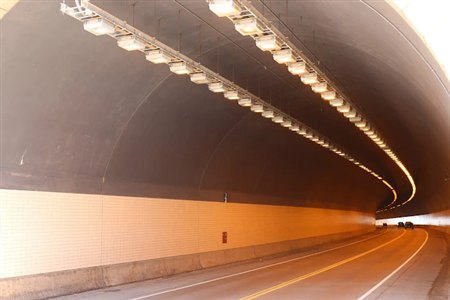
Silver Creek Cliff & Lafayette Bluff Tunnels – Two Harbors, Minnesota
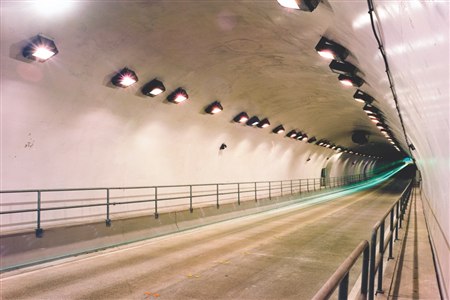
Addison Airport Toll Tunnel (AATT) – Addison, Texas
These installations confirm that CE+T’s modular architecture, wrap-around MBS, high-efficiency conversion, and SCADA-ready monitoring translate successfully from specification to operating asset—often in constrained real-estate conditions and under aggressive commissioning schedules.
Conclusion
For tunnel and bridge owners, the cost of a single lighting outage during an emergency is measured in life-safety risk and public confidence. For Design-Builders, the cost of a non-compliant or oversized UPS package is measured in schedule delay, redesign, and contingency. CE+T America solves both problems simultaneously by delivering a fully engineered, specification-matched static UPS solution—not a commodity product—backed by a North American service network and a growing portfolio of transportation references.
The result is resilient backup power that meets or exceeds every critical clause of the lighting-UPS technical requirements while improving total cost of ownership, reducing project risk, and ensuring that the lights stay on when they matter most.
For more information on resilient UPS solutions for tunnel and bridge infrastructure, contact Senthil Srinivasan, Director of Operations & Product Development, at s.srinivasan@cetamerica.com or +1 678-710-5584.